
How to Check Criminal History in Frisco
Start with the office that made the Frisco record. Frisco Police keeps incident and arrest reports. Frisco Municipal Court holds town summons and citation files. Summit County Sheriff records a custodial booking, while Summit County Combined Courts keeps state filings. CBI may later receive arrest and disposition data for a statewide history. Each source answers a different question.
- Identify whether Frisco Police or another agency handled the event.
- Use the Frisco Police Records Request Form for police and municipal court records.
- Read the ticket to identify Frisco Municipal Court or Summit County Combined Courts.
- Contact Summit County detention for custody and the county clerk for a state case.
- Use Colorado ICHC for a name search or approved fingerprints for identity-assured self-review.
Frisco Police Form, Not CORA
The Frisco open-records page repeatedly warns that its general CORA form is not for police or municipal court material. Send those requests to Police Records. The distinction is practical: town business records and criminal justice records follow different laws, reviews, and forms.
The police form asks for the requester's name, street, city, state, ZIP, contact information, identifying incident details, affirmation, signature, and date. Describe whether the desired product is an incident report, a municipal citation file, or related media. A narrow request helps staff locate and review the right item.
Frisco asks requesters to affirm that official-action and criminal records will not be used for direct solicitation for pecuniary gain. Read the affirmation before signing. A complete request should also separate a police narrative from court disposition, since the offices may review and release those products differently.
The general CORA form visibly requests the date, applicant name, phone, email, department, and description, but those fields do not make it the right channel for a police file. Frisco's warning controls. Use the criminal justice form, include the incident or citation facts, and sign its CCJRA affirmation. If uncertain which product exists, call Police Records at 970-668-3579 before sending duplicate forms.
The official request form shows the current city workflow.
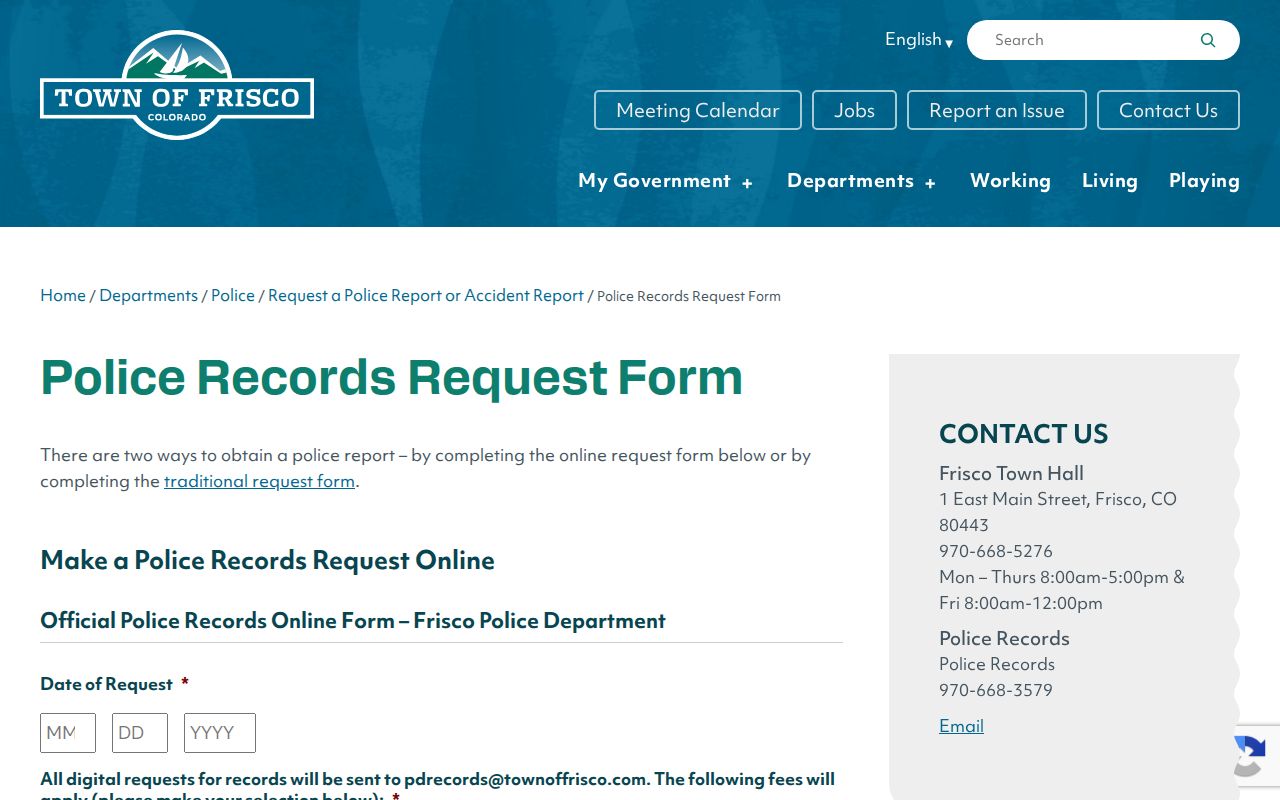
Its separate fields reinforce why a specific report description and signed affirmation matter.
Frisco Police Department Records
The Frisco Police Department is the custodian for records made by town officers. Its form says records can identify a person contacted by police, dates of contact, and charges whether or not incarceration followed. A jail-only search can therefore miss a Frisco contact or citation.
Criminal justice requests must use the Police Records Request Form, not the general CORA form. Provide contact and address details, the event date and place, the report or citation number, a clear description, and the required use affirmation. Mail and email routes are available when a requester cannot appear.
The Frisco Police hub is the official starting point.
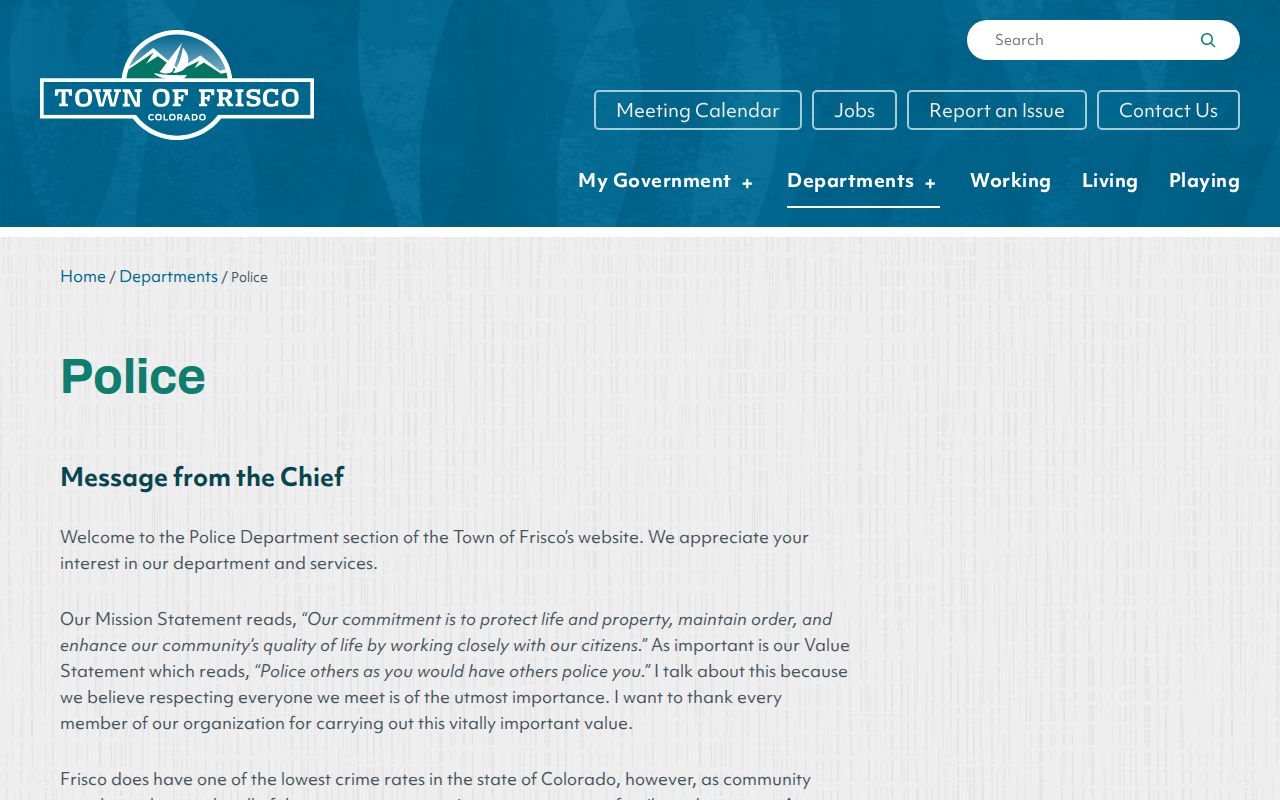
Use its current links and phone details before submitting a Frisco records request.
Frisco Records Without Jail Booking
A police record can exist without incarceration. Frisco's own request form says a record may contain identifying details about a person contacted by police, dates of contact, and charges whether or not incarceration followed. A negative jail inquiry therefore cannot clear the local police channel.
This distinction helps a person reviewing their own contact. A citation, field contact, or released report may remain with Frisco Police even when there was no booking. Search the municipal or state court only when the ticket or later filing shows that a court record should also exist.
A custodial arrest creates a different chain. Summit County detention records the booking, while Frisco Police keeps its narrative. A municipal allegation stays with Frisco Municipal Court, and a state filing moves to Combined Courts. Follow the ticket and case number instead of treating the absence of incarceration as proof that no agency or court record was made.
Use the police report for what the officer recorded and the court file for the legal result. If no summons or charge was filed, there may be no court case even though Frisco Police still has an agency record.
Arrests and Bookings in Frisco
No separate Frisco jail was found in the official research. Custodial arrests move to Summit County detention. Frisco Police still holds the agency narrative, while the Sheriff holds booking and custody data. If charges are filed, the correct court creates another record. One arrest can thus produce several files.
Summit County did not expose a verified public booking blotter during research. Contact detention for a recent custody check, then use the ticket or filed case to identify the court. Booking status is not proof of guilt, and the prosecutor's filed count can differ from the initial booking charge.
Frisco Tickets Name Their Court
Do not guess venue from the agency name. A Frisco officer may issue a municipal summons or a state citation. A ticket naming Summit County Justice Center belongs with the state court in Breckenridge. A Frisco Municipal Court ticket stays with the town.
The municipal court accepts published payment routes online, by check or money order mailed to PO Box 4100, and by phone credit card at 970-668-3579. Payment access is not a complete criminal history search. Contact the clerk at 970-668-3025 for a court copy or certified disposition.
The official Municipal Court page carries current court directions.
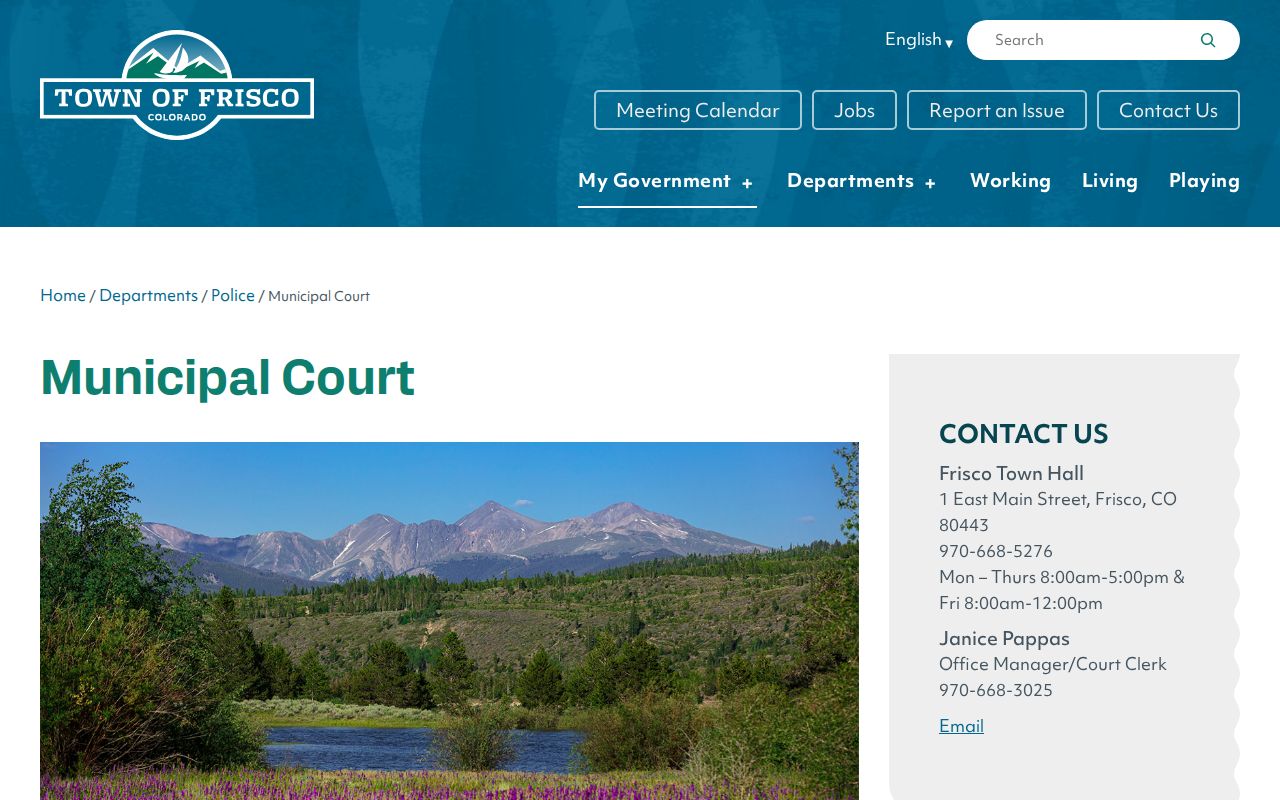
The court page should be checked again before a hearing or payment because schedules can change.
Frisco Municipal Court Records
Frisco Municipal Court maintains municipal tickets and summonses involving traffic, minor criminal, animal-control, and town-code matters. Court meets the third Wednesday monthly at 4:30 p.m. If a ticket names Summit County Justice Center, it is a state citation handled at 501 North Park Avenue in Breckenridge. The ticket, not the officer's uniform, controls the first routing choice.
| Court Name | Frisco Municipal Court |
|---|---|
| Case Types Heard | Municipal traffic, minor criminal, animal-control, and town-code matters |
| Case Lookup Channel | Court clerk and Frisco Police Records Request Form |
| What the Docket Shows | Summons, court dates, pleas, rulings, payments, and disposition when public |
| Copies & Fees | Request copies and a current estimate; no uniform fee was verified |
Frisco Fingerprints Use IdentoGO
Frisco Police does not provide fingerprinting. The department directs readers to IdentoGO because Colorado uses commissioned private vendors for electronic capture. Search the vendor appointment system for a current site, service code, and fee rather than assuming the police counter can take prints.
This route matters for identity-assured self-review. Colorado ICHC is a name-based search and can produce false matches or miss records. A local report request, a statewide name check, and a fingerprint-based record review remain distinct products.
Where Frisco Records End Up
A Frisco matter can remain in municipal court or move to Summit County Combined Courts as a state case. A custodial arrest adds a Sheriff booking record. Fingerprints and reported dispositions may later reach CBI's Colorado criminal history system.
Record flow: Frisco Police › Frisco Municipal Court or Summit County Courts › Colorado Bureau of Investigation
Police records are strongest for the first narrative. The court file shows the filed charge and outcome. CBI offers broader Colorado scope, but exclusions and reporting gaps mean it does not replace local source records.
Reading Frisco Police Activity Reports
Frisco council packets have included Police and Municipal Court Activity Reports. They can count calls for service, felony and misdemeanor arrests, warrants, crashes, citations, pleas, dismissals, and court appearances. Such a report is a dated operational snapshot, not an annual crime rate.
Use only a recent official packet for current figures. Calls are not crimes, arrests are not convictions, and a month shaped by visitor volume should not be treated as a measure of resident conduct.
When citing a packet, preserve its month and year. Compare like fields across periods and check whether reporting definitions changed. Operational data can explain workload, but it cannot determine the outcome of an individual Frisco report or case.
The official DOLA series ranked Frisco third among Summit County towns at 2,859 residents in 2021. That figure establishes page selection, not a current crime rate. Resort traffic and seasonal visitors can affect calls and court work without changing the permanent count in the same way. Current claims should use a current official activity report and label its time span.
Frisco's municipal policies page documents its current web framework.
That framework supports public access but does not merge town, police, and court files.
Frisco Arrest News Versus Results
A May 2025 town release announced an arrest in the Meadow Creek wildfire investigation. That release documents what police reported then. It does not prove the later filed charge or final outcome.
Follow a named event from the announcement to the police record, then to the correct court register. Frisco also published an officer-contact explanation that describes officer identification and how contacts may be documented.
The town's police contact resource shows those details.
It helps readers understand how an encounter can become an agency record before any court filing.
Public Access Rules for Frisco Records
The Colorado Criminal Justice Records Act governs police and criminal justice records. It distinguishes records of official action from investigative files and permits lawful withholding or redaction for active cases, juveniles, victims, medical facts, protected addresses, or safety needs. CORA covers many general town records, but Frisco expressly routes police and municipal court requests to its criminal justice form.
Key Statutes:
CCJRA, C.R.S. §§ 24-72-301 through 309 governs criminal justice record access.
C.R.S. § 24-72-305 addresses inspection and custodian discretion.
CORA, C.R.S. §§ 24-72-200.1 and following covers many noncriminal town records.