
Criminal Cases in Summit County Courts
Summit County Combined Courts is the central custodian for Colorado state cases filed here. District Court hears felonies and district-level post-judgment matters. County Court handles state misdemeanors, traffic cases, and preliminary felony proceedings within its authority. Both clerks work from the Justice Center at 501 North Park Avenue in Breckenridge. The Fifth Judicial District also covers Eagle, Clear Creek, and Lake Counties, but a record request still goes to the county where the case was filed.
Town cases sit outside that state-court file. Breckenridge and Frisco each have a municipal court. Silverthorne, Dillon, and Keystone share a combined municipal court. Those courts retain ordinance, minor criminal, traffic, parking, and related citation records. A Summit County court search can therefore return no state case even when a valid municipal record exists.
Summit Criminal Courts by Charge
The level and location of the alleged offense determine the record holder. This split matters because a municipal clerk cannot certify a District Court disposition, and the Combined Courts clerk does not maintain a Frisco summons.
| Court | Typical criminal scope | Contact |
|---|---|---|
| Summit District Court | Felonies and district-level post-judgment matters | 970-453-2272 |
| Summit County Court | State misdemeanors, traffic, initial felony matters | 970-453-2241 or 970-453-2272 |
| Breckenridge Municipal Court | Town ordinance and minor cases | 970-547-3127 |
| Frisco Municipal Court | Frisco tickets and summonses | 970-668-3579 |
| Silverthorne combined court | Silverthorne, Dillon, and Keystone matters | 970-262-7304 |
How to Search Summit County Case Records
Begin with the Colorado Judicial Branch docket page for calendars and hearing information. An authorized register service can assist with party and case research, while the clerk supplies the register of actions and actual documents. Select Summit and the proper court level. A case number is stronger than a name alone, especially when people share names.
- Open the official docket tool and select Summit County.
- Choose District or County Court, or contact the proper municipal clerk.
- Use the court case number when known; otherwise narrow a name search with filing details.
- Record the filed counts, status, next event, and disposition shown.
- Ask the custodian for the register, pleadings, judgment, or certified disposition needed.
| Field Label | Type | Required | Notes |
|---|---|---|---|
| County | Dropdown | Yes for local results | Select Summit |
| Court | Dropdown | Channel dependent | District or County |
| Date | Date picker | Usually for calendars | Use a hearing date or range |
| Party or case number | Text | Optional | Availability differs by service |
| Division | Dropdown or text | Optional | Use criminal where exposed |
CoCourts and Summit Case Registers
The free state docket is best treated as a calendar, not the full court file. The CoCourts register search is an authorized route for broader case research, and the Summit clerk remains the source for official copies. The manifest capture below shows the register-search source without exposing a private litigant.
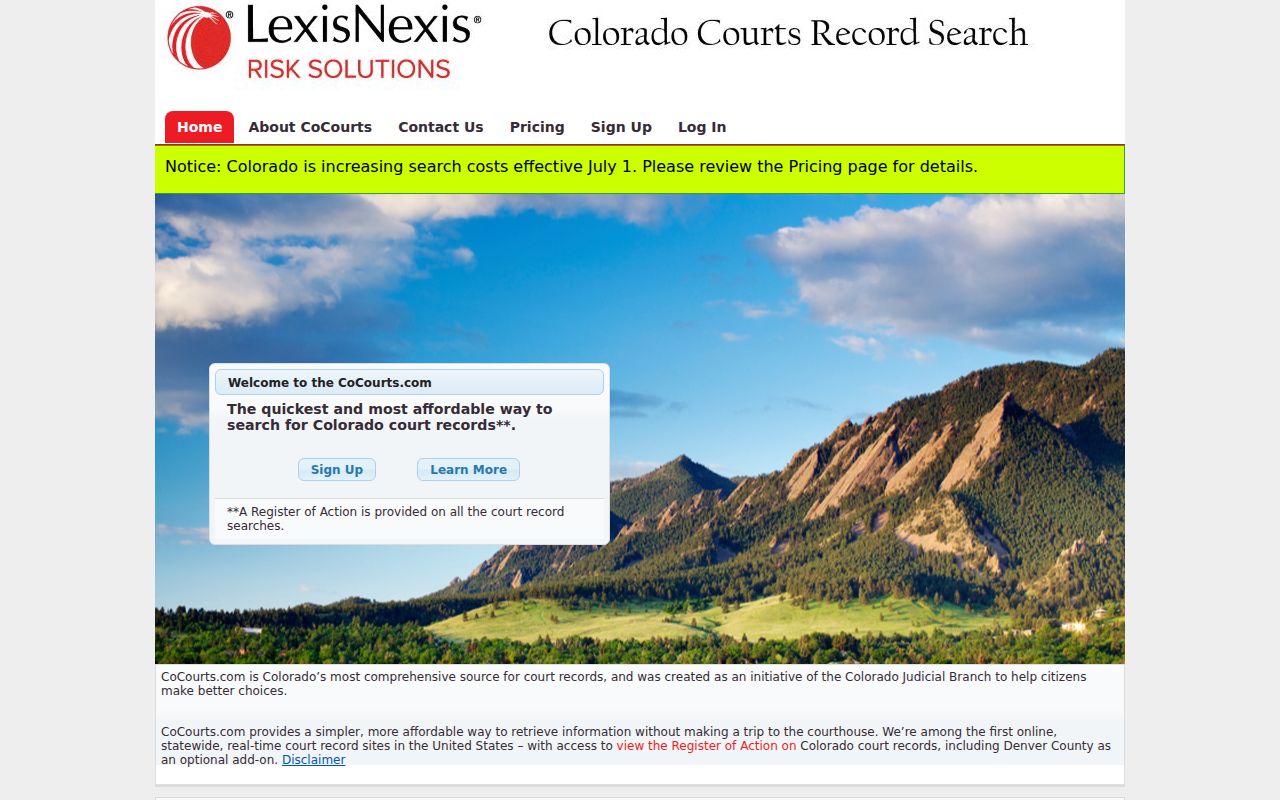
A search result may identify a case and its events, but pleadings, orders, and certified judgments may require a paid clerk request. Confirm current copy, certification, archive, and research charges with the exact court. Summit research did not safely verify one current fee schedule that applies to every court.
What a Summit Case File Shows
A public case file ties the court, filed counts, events, and result together. It can show how a charge changed after arrest and whether each count ended in a plea, dismissal, acquittal, deferred judgment, or another disposition. The event log is often called the register of actions.
| Case number and court | County, court type, division, filing date, and status. |
|---|---|
| Charging document | Counts, descriptions, Colorado statutes, classes, and offense dates. |
| Docket entries | Complaint, bond, counsel, motions, plea, trial, judgment, and review events. |
| Hearing dates | Date, time, courtroom or division, event, and judicial officer. |
| Disposition and judgment | The result for each filed count, not merely the arrest allegation. |
| Sentence and conditions | Public custody, probation, fines, costs, and restitution information. |
Municipal Cases Summit Searchers Miss
Municipal details prevent many false dead ends. Breckenridge Municipal Court distinguishes the citation number, used by the court, from the police case-report number. Entering the report number as a court case number will not locate the same record. The court and police file are related, but they are not interchangeable.
Frisco Municipal Court keeps its town tickets and summonses and meets on the third Wednesday monthly at 4:30 p.m. The Silverthorne, Dillon, and Keystone combined court publishes its own clerk route and generally requires an in-person appearance unless staff authorizes another process. Search the town court whenever the citation came from town police.
Stages of a Summit County Criminal Case
The sequence begins with an arrest, citation, or summons, but the prosecutor decides what to file. Bond review may occur early. A felony may include preliminary procedures before arraignment. Discovery and motions follow, then a negotiated plea or trial. Each filed count receives its own result, and sentencing follows a conviction or plea. Review, probation, custody, or appeal can add later entries.
Case flow: Arrest or citation › Advisement › Prosecutor filing › Arraignment › Pretrial › Plea or trial › Disposition › Sentencing
Filed counts can be amended or dismissed. That is why the court disposition, not the booking charge, answers what the case became.
Older Summit Criminal Case Retrieval
An older or non-digitized case may not appear through the same online route as a current docket. Contact the Summit clerk and provide the defendant name, approximate filing year, court level, and case number if available. Ask whether archive retrieval, staff research, copying, or certification costs apply before ordering.
For municipal files, use that town's custodian. Silverthorne accepts a public-record request by clerk channels and requires payment before processing. Frisco routes police and municipal-court records through its criminal-justice records form, not its general CORA form. Breckenridge links its own fee schedule through Municipal Services. Never assume one court's rates or request form governs another.
Reading Summit Criminal Dispositions
Read the result count by count. A docket may show guilty, dismissed, acquitted, deferred judgment, or another coded outcome beside each filed charge. One case can contain several different results. The charge named in a police report is only the arrest-stage allegation, and even the first court complaint can later be amended.
- Disposition
- The formal result recorded for a filed count.
- Deferred judgment
- A plea with judgment held back while court conditions are completed.
- Register of actions
- The dated event log for filings, hearings, orders, and judgments.
- Certified copy
- A clerk-authenticated document used when an official court record is required.
If a CBI history says disposition unknown, order the correct Summit or municipal disposition and use CBI's update process. Do not infer the outcome from a missing entry or from the fact that a person left jail.
Summit Case Access and Restrictions
Colorado court access follows court rules and the Colorado Revised Statutes. Public displays suppress full Social Security numbers, protected addresses, victim and minor information, and sealed content. Juvenile files, sealed adult cases, medical information, and some supervision records can be withheld or restricted. A blank search result does not prove that no case exists.
Ask the clerk whether the file is archived, municipal, sealed, or simply outside the search channel. Adult relief is usually called record sealing; juvenile matters use a separate expungement process. A public restriction does not mean the state erased every agency copy.